



Immersive Experience Trends and Key Statistics in 2025
Imagine walking through ancient Rome, performing surgery, or shopping for furniture—without ever leaving your home.
The impact of immersive experiences on industries like healthcare, education, entertainment, and retail has been significant, transforming how they engage audiences through immersive technologies.
These tools have revolutionized customer experiences by providing engaging and interactive content.
The growth of immersive experiences is evident, with various sectors adopting these technologies to solve problems, enhance learning, and deliver exceptional customer experiences.
The development of VR, AR, MR, and XR has introduced new methods for content delivery and innovative approaches to business, employee training, and product creation.
From virtual reality to projection mapping, immersive technologies are rapidly changing how people learn, shop, and interact. This article explores the latest market trends, key technologies, real-world industry applications, and what the future holds for businesses and consumers in 2025 and beyond.
Immersive Experience Market Overview and Growth Projections
The immersive experience market is booming, and 2025 marks a tipping point. As industries double down on virtual and augmented solutions, immersive technologies are rapidly evolving from niche tools to mainstream essentials.
Global Market Size and Forecast
The global immersive experience market is projected to reach approximately $144.17 billion by 2025, growing at a CAGR of 23.41% from 2025 to 2030. This growth encompasses hardware (VR/AR headsets and sensors), software (content platforms and AI-enhanced applications), and services (training, maintenance, and support).
To contextualize this surge, the market was valued at approximately $92.61 billion in 2023, which indicates a significant expansion in just two years. Enterprise applications, gaming, and immersive training environments are leading revenue streams, with education and healthcare sectors rapidly adopting these technologies.
Regional Market Growth: North America, Europe, Asia-Pacific
North America
North America leads the immersive technology market, holding 42.4% of global revenue in 2023. The region's dominance is driven by strong enterprise demand, a mature tech ecosystem, and significant investments in XR startups. The market is projected to grow at a CAGR of 23.8% from 2024 to 2030, reaching USD 64.7 billion by 2030.
Europe
Europe is experiencing rapid growth in the adoption of immersive technology, driven by government funding for immersive learning and digital transformation in the healthcare and retail sectors. The market is anticipated to reach USD 40.97 billion by 2030, growing at a CAGR of 28.2% from 2024 to 2030.
Asia-Pacific
The Asia-Pacific region is the fastest-growing market for immersive technology, with a projected compound annual growth rate (CAGR) of 23.05% from 2025 to 2034, according to Precedence Research. Countries like China, Japan, and South Korea are leading adoption through large-scale public investment, advanced tech manufacturing, and growing consumer demand for AR/VR experiences. The region’s immersive tech market is expected to reach USD 117.88 billion by 2034.
Key Drivers of Market Expansion
Several trends are accelerating the rise of immersive experiences:
- Remote collaboration: Businesses are investing in virtual workspaces and training environments that mimic in-person interaction.
- Experiential learning: Schools, universities, and corporate L&D teams are turning to VR and AR to improve knowledge retention and engagement.
- Enterprise adoption: From product design to safety training, immersive tech is streamlining workflows and reducing costs across sectors.
- The metaverse effect: As digital worlds gain traction, demand for immersive-ready tools is growing, spanning entertainment, retail, and brand marketing.
Together, these drivers are reshaping how people learn, work, and connect, making immersive experiences not just a trend but a new standard.
Technologies Powering Immersive Experiences
In 2025, top immersive experience trends include virtual events, AR shopping, and MR in education. These trends demonstrate how immersive technology is transforming everyday experiences across various industries. To see it in action, explore real-world examples of how brands use these tools to engage and captivate audiences.
Virtual Reality (VR) Advancements
Recent advances in Virtual Reality (VR) have made experiences more immersive and interactive. Features like wider fields of view, sharper displays, and lower latency create more realistic environments. These improvements are driving adoption in healthcare, architecture, and education, transforming treatment, 3D design, and learning through immersive content.
Augmented Reality (AR) Growth
Augmented Reality (AR) is transforming industries by enhancing real-world environments with digital overlays. Growth is driven by advancements in mobile technology, the increasing availability of devices, and enhanced software.
- Retail experiences a 40% increase in engagement with AR apps.
- AR improves learning efficiency by 30% in education.
- In healthcare, AR use is growing 38% annually for surgeries and patient care.
- Over 70% of consumers expect AR in retail, highlighting demand for immersive shopping.
Mixed Reality (MR) and Extended Reality (XR) Developments
Mixed Reality (MR) and Extended Reality (XR) advance immersive technology by seamlessly blending physical and digital worlds in real-time. By combining VR and AR, they offer unmatched levels of interaction and immersion across various industries.
360-Degree Video & Audio
360-degree video and spatial audio are transforming how stories are told and how people learn. By placing viewers at the center of the action, these tools create fully immersive experiences ideal for media, virtual tourism, and corporate training. For example, travel brands use 360° video to simulate destinations, while broadcasters use it to cover events from multiple perspectives, enhancing viewer engagement.
Projection Mapping
Projection mapping transforms flat surfaces, such as buildings or walls, into dynamic, interactive displays. Used in live events, museums, and retail, it transforms physical spaces into immersive environments without the need for screens or headsets. From product launches to art exhibits, this tech captivates audiences by merging digital content with real-world settings.
Haptic Feedback
Haptic technology adds the sensation of touch to immersive experiences, making them feel more real and responsive. Devices like tactile gloves, vests, and wristbands allow users to "feel" virtual objects or interactions. Haptics is being adopted in VR gaming, surgical training, and remote collaboration, increasing realism and engagement across use cases.
Immersive Experience Applications Across Industries
Immersive technologies are reshaping how organizations train, operate, and engage, offering hands-on learning, real-time collaboration, and safer, more efficient workflows. From education to defense, these tools are driving real-world impact across sectors.
Education
Immersive tech enhances experiential learning through virtual classrooms, 3D simulations, and interactive STEM labs. Students can explore environments such as the human body or outer space, thereby increasing engagement and retention.
Healthcare
VR and AR are used in surgical training, pain management, mental health therapy, and patient education. For example, VR exposure therapy is helping veterans manage PTSD, while hospitals use simulations for risk-free surgical practice.
Corporate Training
Companies utilize immersive platforms for onboarding, soft skills training, and safety training. These methods enhance knowledge retention and reduce training time, thereby saving costs while improving employee performance.
Manufacturing
AR and MR provide step-by-step assembly guides, remote maintenance support, and digital twins for design and operations. These tools streamline processes, reduce errors, and boost productivity on the factory floor.
Aviation
Flight simulation and AR-based pilot training have become standard in aviation. Immersive tech also assists in aircraft maintenance, offering technicians real-time overlays and diagnostics to improve accuracy.
Military and Defense
VR/AR technologies support battlefield simulations, mission planning, and remote collaboration, which allows troops to train in realistic, low-risk environments. Governments are ramping up investments—agencies like the U.S. Department of Defense are funding immersive training to boost readiness, cut costs, and improve coordination.
Advancements in Immersive Technology
Recent years have witnessed remarkable advancements in immersive technology, revolutionizing various industries and opening up new possibilities for human interaction and engagement.
From virtual reality (VR) to augmented reality (AR) and mixed reality (MR), the landscape of immersive tech continues to evolve rapidly.
Normal Text: Future Potential Developments in Immersive Tech:
- Advanced Artificial Intelligence (AI) Integration: AI enhances immersion by personalizing content based on user interactions and preferences, from virtual assistants to dynamic NPC behaviors.
- Expanded Mixed Reality (MR) Capabilities: Future MR devices seamlessly blend physical and digital worlds, offering enhanced spatial awareness and interaction capabilities.
- Biometric Feedback and Emotional Response: Biometric sensors and facial recognition monitor users' physiological responses and emotions in real time, tailoring experiences and optimizing engagement.
- Neurotechnology and Brain-Computer Interfaces (BCIs): Neurotech enables direct communication between the brain and immersive devices, revolutionizing accessibility and interaction paradigms.
- Extended Reality (XR) Ecosystem Integration: VR, AR, and MR technologies converge, enabling seamless transitions between virtual, augmented, and physical realities.
ROI and Positive Impact of Immersive Experience on Businesses
Immersive technologies offer significant returns on investment (ROI) for businesses across various industries.
By integrating immersive experiences into their operations, companies can enhance customer engagement, improve training effectiveness, and streamline processes, ultimately leading to increased revenue and cost savings.
The positive impacts of immersive tech on businesses include:
- Improved Customer Engagement: Immersive experiences like VR product demos and AR shopping boost customer interaction, fostering brand loyalty and driving sales.
- Enhanced Training Effectiveness: Immersive simulations offer hands-on learning, improving knowledge retention, and skill acquisition, and cutting training expenses.
- Operational Efficiency: Immersive tech streamlines workflows via remote collaboration, virtual prototyping, and data visualization, boosting productivity and minimizing errors.
- Competitive Advantage: Embracing immersive tech sets businesses apart, drawing tech-savvy customers and establishing them as market leaders.
Case Studies:
Change the stats and other latest important figures if necessary.
- Ford cut training time by 70% and boosted retention by 90% using VR for assembly line training.
- IKEA’s AR furniture tool increased online sales by 35% and reduced returns by 30%.
- Walmart’s VR training improved employee performance by 10%-15% and a 10% improvement in customer satisfaction.
- Boeing’s MR maintenance system reduced training time—up to 75% per person—compared to traditional methods.
The Future Outlook of Immersive Experience
As immersive technology continues to evolve, experts anticipate several trends that will shape its future. Emerging advancements are expected to drive significant changes in various industries, revolutionizing the way people interact with digital content.
Emerging Trends in Immersive Technologies
New innovations are driving deeper adoption and functionality. AI-enhanced XR personalizes user experiences, while 5G enables seamless, low-latency streaming for mobile AR/VR. Avatar-based collaboration is gaining ground in virtual workspaces, and edge computing is powering real-time responsiveness for more complex, location-specific applications.
Potential for Integration with Other Emerging Technologies
Immersive tech is increasingly intersecting with AI, blockchain, IoT, and digital twins. AI enhances interaction and automation; blockchain facilitates secure virtual transactions; IoT integrates real-world sensors with virtual systems; and digital twins replicate real environments for simulation, planning, and monitoring.
Long-Term Implications for Businesses and Consumers
Immersive experiences will reshape customer engagement, training, and remote work. Businesses should start by identifying high-impact use cases, like virtual product demos or immersive employee training, and invest in scalable platforms. Early adoption will offer a competitive edge as these tools become integral to how people learn, shop, and collaborate.
Key Takeaways
- Immersive tech (VR, AR, MR, XR) is transforming industries through engaging, interactive solutions.
- Rapid adoption is driven by tech advances that make these tools more accessible and effective.
- Businesses that use immersive experiences achieve a strong return on investment (ROI) through enhanced engagement, learning, and efficiency.
Frequently Asked Questions
Can Small Businesses Start Incorporating Immersive Experiences?
Absolutely. Immersive technology offers scalable solutions that are beneficial for customer engagement and training.
Steps include identifying specific business needs, starting with small pilot projects, and gradually expanding as success is measured.
Do Immersive Experiences Influence Consumer Behavior?
Yes, immersive experiences can significantly influence consumer decisions by providing engaging and interactive content that enhances brand perception and loyalty.
Are There Any Privacy Concerns with Immersive Technologies?
While immersive technology offers many benefits, it also raises significant privacy concerns, particularly regarding data collection and user tracking.
Guidelines for privacy include transparent data usage policies, user consent mechanisms, and secure data storage practices.
How to Drive Direct Bookings with Waivers: The Hidden Goldmine in Your Customer Data
Your waivers are more than just legal protection. They're your secret weapon for cutting through the marketing noise and driving repeat bookings directly to your business.
Every tour and activity operator knows the challenge: customers book through third-party platforms, leaving you with minimal data and zero relationship. But what if there was a way to capture valuable customer information from every single guest, not just the person who made the booking? The answer lies in something you're already using every day.
Why Direct Marketing Matters More Than Ever in 2025
Consumers are drowning in generic content. The average person receives dozens of marketing messages daily, and they've become expert at tuning out anything that doesn't feel personally relevant. To break through this noise, you need to be specific, timely, and personal in your approach.
The good news? Direct marketing channels are more effective than ever. Email marketing continues to deliver strong results, with average open rates across industries reaching 42.35% as of 2025. But SMS marketing is the real powerhouse here. SMS messages achieve a remarkable 98% open rate, compared to email's performance, and SMS has a response rate of 45%, compared to email's 6%.
The key is having the right data to make these channels work for you. And that's where your waivers come in.

Your Waivers: A Data Collection Powerhouse
Most operators collect basic information from the primary booker through their booking system. But waivers give you something far more valuable: data from every single guest who experiences your activity.
Think about it. A family of four books a whitewater rafting trip through a third-party platform. You get the name and email of whoever made the booking, but you miss out on connecting with the other three family members who might book again or recommend you to friends.
With digital waivers, you can collect comprehensive information from every guest:
Phone Numbers for SMS Marketing: While email remains important, SMS cuts through the noise instantly. When you have phone numbers from all guests, you can send timely, location-based alerts about perfect weather conditions or last-minute availability.
Birth Dates for Targeted Campaigns: Birthday marketing works because it feels personal and gives people a reason to celebrate. When you know everyone's birthday in a group, you multiply your opportunities for repeat bookings.
Zip Codes for Local Targeting: Some of your best customers are locals who can visit repeatedly. Zip code data helps you identify these valuable segments and create locals-only promotions or perfect conditions alerts.
Group Types and Preferences: Understanding whether guests are corporate groups, families, adventure seekers, or first-timers allows you to tailor future communications and suggest appropriate experiences.
Custom Data Fields: Modern waiver platforms let you collect any information that's valuable to your business. Collect hotel names to identify potential partnership opportunities, skill levels to suggest appropriate follow-up experiences, or special interests to create targeted campaigns.

Turning Data Into Direct Bookings
Collecting data is just the beginning. The real magic happens when you use that information to create personalized, automated campaigns that drive repeat business.
Drive Repeat Business with Automated Campaigns
Birthday Campaigns
- Use birth date data to send personalized birthday offers to past guests
- Example: "Happy Birthday, Sarah! Remember your amazing zip-lining adventure last summer? Celebrate with 20% off your next adrenaline rush."
- These work because they reference specific positive memories while providing clear calls to action
Anniversary Marketing
- Target guests on the anniversary of their visit with return offers
- Example: "It's been exactly one year since your whitewater rafting adventure with us, Mike. Ready for round two? Book this week and save 25% on your return trip."
- Taps into nostalgia while creating urgency through limited-time offers
Segmented Campaigns for Maximum Impact
Location-Based Targeting
- Use zip code data to identify locals within driving distance
- Send weekend availability alerts and perfect conditions notifications
- Example: "Sarah, remember how much you loved kayaking with us? The weather's perfect this weekend and we have spots available!"
Experience Level Progression
- Create pathways based on previous experience difficulty
- Send beginner-friendly offers to first-time guests
- Invite experienced adventurers to try more challenging experiences
- Example: "Loved your intro rock climbing session? You're ready for our intermediate outdoor climbing adventure."
Family-Focused Follow-ups
- Target families with seasonal promotions and age-appropriate activities
- Promote kids' camps to families who visited during previous seasons
- Create family package deals based on group composition data

Boosting Your Review Strategy
Online reviews are often the first thing travelers look at when deciding where to book. More reviews, especially on platforms like Google and Tripadvisor, improve your visibility, build trust, and increase the chances guests will book directly with you.
Most booking platforms and review collection tools only send follow-up requests to the primary booker. But when you collect contact information from every guest through waivers, you can request reviews from everyone who experienced your activity.
With Peek and Wherewolf, you can:
- Automatically send review requests to every guest, not just the booker
- Reach guests via SMS or email with a direct link to your preferred review site
- Run one-off campaigns to boost specific platforms (e.g., a push for Google reviews this month)
- Track performance and see what’s working, all from one dashboard
Operators using Wherewolf see a 307% increase in reviews on average, which helps boost your visibility in search, build trust, and ultimately drive more direct bookings.

Making It Work: Implementation Strategy
The key to success is automation. Set up your campaigns once, then let them run automatically based on the data you collect through waivers. This ensures consistent follow-up without requiring daily management.
Getting Started
Phase 1: Foundation Campaigns
- Start with birthday campaigns and anniversary reminders
- These have clear triggers and typically generate strong response rates
- Build confidence and establish baseline performance metrics
Phase 2: Advanced Targeting
- Expand into location-based campaigns for local guests
- Create segment-specific offers based on experience level and group type
- Use gathered data to refine messaging and timing
Measuring Success
Track Key Metrics
- Monitor open rates and click-through rates across email and SMS
- Most importantly, measure conversion rates to actual bookings
- Use this data to refine messaging and timing for maximum effectiveness
Continuous Optimization
- Test different subject lines and message timing
- Analyze which segments respond best to specific offers
- Adjust campaigns based on seasonal trends and booking patterns

The Takeaway: From Waivers to Revenue
Your waivers represent an untapped goldmine of customer data that most operators are completely ignoring. By collecting comprehensive information from every guest and using it to create personalized, automated marketing campaigns, you can build direct relationships with your customers and reduce dependence on third-party booking platforms.
The businesses that thrive in today's crowded marketplace are those that cut through the noise with personal, timely, and relevant communications. Your waiver data gives you everything you need to create these powerful connections and drive direct bookings for years to come.
Learn more about Peek’s integration with Wherewolf and other tools to drive direct bookings with a demo

How To Ask Customers To Leave A Review for Tours And Activities
Ever had a guest rave about your tour and thought, "I wish everyone could hear this!"?
Online reviews build trust like personal recommendations.
So, more reviews = higher trust, more bookings, and a stronger online reputation.
But most businesses don’t ask correctly, leading to missed opportunities. The right strategy fixes that.
In this guide, you'll learn when and how to ask customers to leave a review for tours and activities, tips, and what to say, along with 10+ real-life examples.
Let’s get started!
When and How to Ask for a Review
Asking for reviews isn’t just about when you ask. It’s also how you do it. Ask too soon, and customers might feel rushed. Ask too late, and they might forget.
Here are best practices on how to ask customers to leave a review:
The Best Time to Request Reviews
Response timing is key—ask at the right moment for better feedback.

Tip: Pick the right time to get the best and most honest feedback. So, don’t rush!
Tone and Wording for Review Requests
Your tone makes or breaks your request. Keep it polite, warm, and engaging. Don’t say, "Review us. It’ll only take a second,” as it sounds demanding and rushed.
Instead, persuade them by saying this: "We hope you had an amazing time on our tour! Your feedback helps us improve and helps future travelers."
This makes it more customer-focused, friendly, and engaging. A friendly, personal tone increases the chances that guests will actually leave a review.
Best Channels to Request Reviews
Different guests prefer different methods. Here are your best bets:

10+ Examples of Effective Review Request Messages for Tour Guides
Ever had a guest leave your tour with so much excitement? That’s the perfect moment to turn their enthusiasm into a good review. But how do you ask without sounding pushy?
Here are some examples to get good customer feedback:
In-Person Request Examples
Imagine this:
After a magical sunset tour, Sarah gathers her guests, still laughing and taking photos, and says:
“Wow, what an unforgettable evening! If you had a great time, we’d LOVE to hear about it. A quick review would mean the world to us!
Tell others about your experience with us. Just scan this QR code—it takes less than a minute!”
This review request feels warm and personal and prompts immediate action.
Email Request Templates
If you’re sending an email after the tour, make sure that you personalize it for each guest. Don’t say: "Thanks for choosing our tour. Leave a review here: [Link]."
Instead, add more context:
"Hi [Name],
We had an absolute blast with you on [Tour Name]!
From [mention a highlight like "spotting dolphins"] to [another highlight], you made it unforgettable.
If you enjoyed it, let the world know how we did!
Help future travelers by sharing your insights here: [Link].
Thanks for touring with us!
Hope to see you again soon.
Cheers,
[Your Name]
[Tour Company]"
See how engaging and welcoming the second one is?
SMS Review Request Examples
SMS is short, instant, and easy—ideal for quick responses. Add emojis for a human touch and urgency for fast action.
Try these messages:
- "Hope you enjoyed [Tour Name]! 🌍 Leave a review in the next 24 hrs & get 10% off your next tour: [Link]."
- "Thanks for joining us! ⭐Got 30 secs? Feel free to share your experience on Google: [Link]."
Social Media Review Request Examples
Social media is where your guests hang out, so meet them there! Platforms like Instagram, Facebook, and WhatsApp are perfect for friendly review reminders. Here’s how:
At the start of the tour, ask the guests to follow you on Instagram.
Then:
1. Post a guest’s photo (with permission!)
2. Add a Story Poll: “Best part of today’s tour? A) The Views B) The Adventure C) The Guide”
3. DM everyone who votes:
“Hey [Name], thanks for voting! Tell us what made your trip memorable. Highlight your favorite moments from the trip here: [ Link]”
Or you could also say, “Share a photo and a review on Instagram with #yourbusinesshashtag!”
Post an album of memorable tour moments and tag them, if possible. Then, share it to their account and send them a message to start a conversation:
“Hi [Name], thanks for joining [Tour Name]!
It was definitely a pleasure meeting you!
If you’ve got 30 secs, help us grow by rating your experience.
Feel free to express your thoughts on our Facebook page/website: [Link].”
Messaging your customers is a great way to build customer relationships.
Like text messages, make it simple and add a human touch with emojis. For example:
“Hey [Name], thanks for joining [Tour Name]! 🌟 We really appreciate it. Let us know what you loved about the tour here 🤩: [link]. It only takes 1 minute!”
QR Code Call-to-Action Examples
QR codes make leaving reviews quick and easy. Guests just scan–no need to type links.
- On-Site Signage at Check-out, Tour Endpoints, or Tour Vehicles: “Enjoyed your experience? Scan here to leave a review!”
- Brochures & Maps: “Loved the tour? Let us know! Scan here to share your experience.”
- Receipts & Tickets: “Thank you for touring with us! Got a minute? Scan here to share your thoughts.”
- Email Signatures: “Enjoyed your experience? Share your feedback—just scan here!”
MDL Marinas Group used QR codes to collect 900+ emails in just 3 weeks.
“It seems that everyone is happy to scan and access the QR codes.” – MDL Marinas
And guess what? Even guests over 55 had no trouble using them! QR codes make review collection effortless for all age groups.
Automating Review Collection for Consistency
Manual review requests are slow, inconsistent, and easy to forget, which leads to missed opportunities. Automation fixes this.
- Manual: Requires constant follow-ups and often gets ignored.
- Automated: Sends timely, personalized requests effortlessly.
Timely requests boost conversions with less effort. In fact, 65% of customers leave reviews when asked promptly.
Why Customer Reviews Matter for Tours and Activities
Customer reviews influence 63% of travelers and boost SEO. Businesses with 50+ Google reviews also rank 20% higher, proving that reviews build trust and drive bookings.
Take Ocean Blue Tours in Hawaii. They struggled with slow bookings until they started asking for reviews. This raised their TripAdvisor rating from 4.2 to 4.8 in six months.
The takeaway? More reviews = more trust, higher rankings, and more bookings.
What to Avoid When Asking for Customer Reviews
Imagine finishing a relaxing sunset cruise only to get this message: "Hey, leave us a 5-star review ASAP. It’ll help us a lot!"
Feels pushy, right?
Compare that to: "We hope you loved your sunset cruise experience! Your feedback means the world to us. Feel free to leave a review on our website [link]."
A warmer, genuine request encourages positive responses, leading to more reviews and better engagement.
Asking for reviews seems easy, but if done wrong, it can backfire.
Avoid:
- Demanding reviews.
- Sending generic review requests.
- Asking for reviews at the wrong time.
- Ignoring negative feedback instead of addressing it professionally.
- Overloading customers with multiple review requests.
- Offering incentives in exchange for positive reviews (violates platform policies).
- Using confusing review links.
- Failing to follow up after the initial request.
Authentic, respectful requests build trust, boost feedback, and enhance credibility.
Key Takeaways
- Immediate post-tour requests and friendly messages yield more positive reviews.
- Use different channels for review collection, depending on your target audience.
- Automation tools can help you collect reviews with minimal effort.
Frequently Asked Questions
Can I Ask for Reviews on Multiple Platforms?
Yes. However, avoid overwhelming customers with multiple requests on different review platforms. Instead, give them a choice by including links to different review sites in a single message.
Can Customers Edit Their Reviews After Posting?
Yes! Platforms like Google, TripAdvisor, and Yelp allow users to edit reviews by logging in and selecting ‘edit.’
What to do If a Customer Leaves a Fake Negative Review?
Flag the review as inappropriate on Google, TripAdvisor, or Yelp and submit evidence (e.g., booking records) to support your claim. If not removed, respond professionally. Clarify misinformation and show transparency to build trust.

7 Best AI Tools Every Travel Agent Should Consider
For a travel agent, 24 hours never feels like enough—juggling last-minute changes, endless client inquiries, and complex itineraries can quickly turn into chaos.
This is exactly where AI-powered tools come in. Even while you sleep, they analyze booking patterns, automate customer communication, and forecast travel trends—helping you save time, personalize experiences, and enhance client satisfaction.
In this article, we cover seven AI tools that redefine what's possible in travel planning so you can elevate your client’s experience. Whether you're looking for smarter itinerary planning, automated customer support, or data-driven insight, you’ll find an AI solution in our list.
1. ClipDrop
A blurry hotel room photo won’t inspire bookings, but a stunning, high-quality image will. That’s where Clipdrop comes in.
Clipdrop is an AI-powered image enhancement tool that sharpens details, improves lighting, and removes unwanted objects in seconds. It helps travel agents market their services more effectively without a design team.
For example, if a hotel sends a low-quality room image or a scenic shot that looks dull, you can use Clipdrop to clean up and refine the images to make every destination look as appealing as possible.
With eye-catching travel brochures, engaging social media posts, and polished promotional content, Clipdrop gives travel agents a competitive edge in a visually-driven industry.
2. Pruvo
Did you know that 40% of hotel bookings experience a price drop after reservation? If you’re not tracking them, you’re leaving money on the table—for both you and your clients.
Pruvo’s AI-powered price-tracking system monitors hotel bookings after confirmation. When it finds a lower rate for the same stay, it automatically rebooks at the better price without the hassle of constant monitoring.
This enhances travel package customization and allows travel agents to maximize value without manually tracking prices. Clients save money, and happy clients mean repeat business and referrals.
3. GuideGeek
Handling last-minute client questions while juggling itineraries? GuideGeek eliminates repetitive inquiries by providing real-time, AI-powered travel recommendations—freeing up valuable time for travel agents.
Imagine a client lands in Rome and texts, "Where’s the best spot for authentic carbonara?" GuideGeek instantly responds with highly-rated restaurants, pricing, and alternative dishes to try.
Or, the client needs last-minute subway directions in Tokyo? GuideGeek provides real-time routes, estimated travel times, and fare details—without the agent lifting a finger.
With instant answers and seamless destination insights, GuideGeek enhances customer experience while saving travel agents hours of work.
4. Vacay
Vacay is an AI-powered travel planner that personalizes trip recommendations and streamlines itinerary planning.
Let’s say a client dreams of a luxury food & wine tour across France. Instead of manually researching vineyards, boutique hotels, and Michelin-starred restaurants, a travel agent turns to Vacay.
In seconds, the Vacay generates a tailor-made itinerary featuring private tastings in Bordeaux, a Michelin-starred dinner in Lyon, and a hidden gem patisserie in Paris—all aligned with the client’s budget and travel style.
With instant, AI-curated travel plans, Vacay transforms how agents plan dream vacations.
5. Mindtrip
Every traveler wants a unique experience—Mindtrip ensures they get exactly that. This AI-driven platform analyzes past bookings and traveler conversations to refine itineraries based on individual preferences.
Think of a traveler who loves adventures but avoids crowded spots. Mindtrip curates a personalized itinerary, including a seculded rainforest hike in Costa Rica or a private hot air balloon ride in Cappadocia.
Beyond just planning, Mindtrip’s AI chat interface enhances agent-client interactions. It captures traveler preferences in real time, ensuring more tailored recommendations—without endless back-and-forth emails..
6. Trip Planner AI
Trip Planner AI automates trip planning with real-time data, adjusting for flight delays, weather changes, and local events.
For example, if a client’s flight gets delayed, Trip Planner AI can adjust tour times or suggest alternative activities. Just input key details—destination, travel dates, preferences—and Trip Planner AI will list up-to-date recommendations hassle-free.
Travel agents can save hours on itinerary planning, providing personalized, up-to-date travel suggestions effortlessly.
7. Salesforce Travel CRM
Salesforce Travel CRM helps travel agencies manage leads, automate bookings, and personalize follow-ups. The best part? Everything lives in one easy-to-use dashboard, where you can view client details, itineraries, follow-ups, and booking history.
Now, imagine sending a Maldives package to a client who just mentioned their anniversary or suggesting ski destinations to families who book winter getaways. They are more likely to book because the offer feels relevant and thoughtful.
This improves lead generation for travel agencies, boosting conversion rates. Happy customers are more likely to book again and even recommend your services to others.
How Travel Agencies Can Benefit from Using AI
AI-powered tools help travel agencies work more efficiently while delivering outstanding service. Here’s how:
1. Automation of Routine Tasks
AI can handle bookings, itinerary changes, and customer inquiries, freeing travel agents to focus on high-value services and client relationships.
2. Enhanced Customer Experience
AI translates languages in real time and provides chatbot-assisted support 24/7, from flight delay alerts to local restaurant recommendations. It supports voice search for travel inquiries, boosting customer satisfaction and loyalty.
3. Personalized Marketing Strategies
AI optimizes advertising campaigns by analyzing past bookings and traveler preferences. This technology allows you to send hyper-targeted offers—like luxury cruises for high-end travelers or family-friendly resorts for parents—boosting conversion rates and repeat bookings while eliminating generic mass emails.
4. Improved Operational Efficiency
Advanced AI can analyze booking patterns you might miss and flag upcoming travel trends. This allows travel agencies to make data-driven decisions like where to invest and when to scale back.
How to Integrate AI Tools into Existing Workflows
Simply adopting AI-powered tools isn’t enough—they must integrate seamlessly into existing processes to maximize efficiency. Here’s how you can make the transition smooth and effective:
Assessing Current Business Processes
Before implementing AI, agencies should evaluate their workflows to identify inefficiencies and areas that slow down operations. Common areas where AI can improve efficiency include:
- Customer Service: AI chatbots provide instant responses 24/7, reducing wait times.
- Itinerary Planning: Automated tools generate personalized travel plans in seconds.
- Marketing: AI analyzes customer data to create targeted promotions.
Choosing the Right AI Tools
It’s important to choose AI solutions that align with your budget, goals, and operational needs to ensure a smooth transition and maximum ROI. Agencies should consider:
- Ease of Use – Is the tool user-friendly for agents and clients?
- Integration Capabilities – Can it connect with existing booking systems and CRMs?
- Scalability – Will it grow with your business and evolving client needs?
Training Staff on New Technologies
Remember, even the best AI tools are ineffective without proper training. AI is used for support and not as a replacement. Best practices for training include:
- Hands-On Demos – Provide interactive training sessions for real-time learning.
- Gradual Implementation – Introduce one AI tool at a time to avoid overwhelming.
- Ongoing Support – Regular check-ins to ensure staff are comfortable with new tools.
How Much Do AI Tools for Travel Agents Cost?
AI travel tools range from free plans to enterprise-level custom solutions, depending on features, payment model, and agency size. Here’s what impacts pricing:
- Subscription-Based vs. One-Time Payment: Many AI solutions operate on a subscription model (monthly or annually), while some offer one-time purchases that might save money in the long term.
- AI Features Included: Basic plans cover chatbots, automation, and itinerary planning. Costs climb with premium features like customer service automation, itinerary planning, or marketing analytics.
- Enterprise-Level Solutions: If you're running a larger operation, expect custom pricing packages offering scalability and deeper integrations to accommodate your extensive needs.
Key Takeaways
- AI tools help travel agents save time, improve customer experiences, and streamline operations—from automating bookings to providing real-time recommendations.
- Aside from budget and needs, look for features like automation, customer insights, and seamless integration when choosing an AI tool for your agency.
- Successful AI adoption requires proper implementation. To achieve the best results, evaluate your workflow, select the right tools, and train your team.
Frequently Asked Questions (FAQs)
Can AI Help Travel Agents Personalize Travel Recommendations?
Yes. AI analyzes customer preferences and real-time data to understand travel habits, budgets, and interests to create tailored trip suggestions.
Can AI Help with Fraud Detection in Travel Bookings?
Yes. AI detects fraud in transactions by analyzing booking patterns, payment histories, and customer behaviors.
Can AI Tools Handle Complex or Unusual Travel Requests?
Yes, but with some limitations. Human expertise is still essential for highly specialized trips, such as extreme adventure travel or niche cultural experiences.

Latest Escape Room Industry Trends in 2025
Escape rooms have taken the world by storm, captivating millions with their thrilling, mind-bending puzzles and immersive experiences. As we enter 2025, the escape room industry trends continue to show increased investment in immersive experiences, constantly evolving to meet the growing demand for interactive, unique entertainment.
At their core, escape rooms are live, interactive games where players must collaborate to solve puzzles, find clues, and escape within a predetermined time limit. They challenge participants mentally and physically, creating a memorable experience that leaves a lasting impression.
In this guide, we’ll explore key trends influencing the industry's trajectory in 2025, providing insights into the industry's future and how to succeed in this rapidly growing market.
Key Trends Shaping the Escape Room Industry
The escape room industry is dynamic and ever-evolving, shaped by trends that reflect changing customer preferences and technological advancements. If you’re thinking of starting an escape room business, here’s a look at the key trends currently influencing the direction and growth of escape rooms worldwide.
Increasing Reliance on Online Bookings
In today's digital age, the convenience of online bookings has become a fundamental expectation for customers seeking entertainment options. Escape rooms are increasingly leveraging digital platforms to facilitate easy, seamless booking experiences. This trend streamlines the reservation process and enables businesses to analyze data to predict demand, customize marketing efforts, and enhance the overall customer experience. As a result, a robust online presence and booking system are now critical components for the success of escape room businesses.
Accepting Gamification and Story-Driven Experiences
The essence of escape rooms lies in their ability to engage players through compelling narratives and gamified challenges. There’s a growing trend towards creating deeply story-driven experiences that immerse participants in the plot, making them active characters in their own adventure. This emphasis on storytelling and gamification enriches the escape room experience, making it more memorable and emotionally impactful for players.
Embracing Immersions Powered by Technology and Integrating Virtual Reality
Technology is revolutionizing the escape room industry by enhancing the immersive quality of experiences. The integration of Virtual Reality (VR) and other advanced technologies has opened new dimensions of interactivity and realism, allowing players to be transported to entirely new worlds. These technologically advanced rooms offer unprecedented levels of engagement and have the potential to revolutionize the standard escape room format, providing a competitive edge in the market.
Focusing on Teamwork and Goal-Oriented Themes
Escape rooms naturally promote teamwork and collaboration. These themes often revolve around solving a larger mission beyond just escaping the room, encouraging players to work together towards a common objective.
This trend amplifies the fun and challenge, positioning escape rooms as valuable tools for corporate training that enhance teamwork, communication, and problem-solving skills in a fun and engaging environment.
Market Expansion and New Formats
Escape rooms show increasing popularity worldwide, with franchises such as PanIQ Room expanding into international markets, including the U.S., Europe, and Asia.
The industry continues to indicate expansion into new markets, with new formats and escape room themes gaining traction, such as outdoor escape experiences and VR-based rooms. These formats highlight growth in target demographics, appealing to tech-savvy and adventure-seeking audiences.
Consumer Demographics and Trends
The escape room industry is experiencing a shift in consumer behavior, with a growing focus on group experiences that demonstrate diversification of themes. Escape rooms now cater to a variety of interests, including pop culture, historical events, and mystery-based scenarios, reflecting changes in customer preferences.
Additionally, create different kinds of escape rooms tailored to couples, families, friends, and employees for team-building purposes, targeting multiple markets.
Health and Safety Trends
Escape room operators have showcased adaptation to post-pandemic conditions by implementing rigorous health and safety measures, including enhanced sanitation practices and social distancing protocols.
These efforts also reveal innovation in game design by incorporating touchless technology and increased use of digital booking platforms to ensure a seamless and safe experience.
As the industry reflects growing interest in puzzle complexity, safety and cleanliness remain top priorities for continuing to provide enjoyable, immersive experiences while prioritizing public health.
Strategies to Succeed in the Escape Room Business
Succeeding in the escape room business requires a blend of creativity, innovation, and strategic planning. As the industry becomes increasingly competitive, these strategies can help your business stand out and grow.
Marketing Strategies for Growth
Effective marketing is crucial for attracting and retaining customers. Utilize social media to engage your audience with intriguing content, behind-the-scenes looks, and special promotions. Implement targeted advertising to reach potential customers based on interests and location. Collaborations with local businesses and influencers can also expand your reach. Additionally, encourage word-of-mouth marketing by offering exceptional experiences that customers will want to share with their networks.
Enhancing Customer Experience with Technology
Leveraging technology can significantly enhance the customer experience before, during, and after the game. Implement online booking, customer review, and waiver systems for convenience. Inside the rooms, integrate advanced technologies like VR, AR, and app-based clues to create immersive and interactive experiences. Post-experience, use technology to provide personalized feedback or photos that customers can share on social media, turning them into advocates for your brand.
Escape Room Industry Challenges
The escape room industry faces several challenges–things that you may need to consider when building your own escape room business.
- Rising Competition and Market Saturation: Difficult to market your escape room business and make it stand out due to fierce competition in urban and suburban markets
- Balancing Game Difficulty with Customer Expectations: Must know how to strike the right puzzle difficulty and ensure player satisfaction without frustration
- Legal and Safety Concerns in Escape Room Design: Should always adhere to fire safety regulations, structural integrity, and ensure safe use of props
In light of these challenges, it’s important for your businesses to continuously adapt and innovate. The industry reveals rising competition within the industry, and staying ahead requires thoughtful planning, a deep understanding of customer preferences, and compliance with regulations.
Future Outlook of the Escape Room Industry
As of 2025, the global escape room market was valued at approximately $9.02 billion in 2024 and is expected to reach $10.22 billion in 2025, continuing to grow at a CAGR rate of 13.91%. By 2030, the market could potentially reach $19.73 billion.
The escape room industry is evolving rapidly, with advancements in technology and a growing focus on innovative, sustainable practices shaping its future.
Here are some examples of future innovations and trends that you can integrate into your escape room facilities:
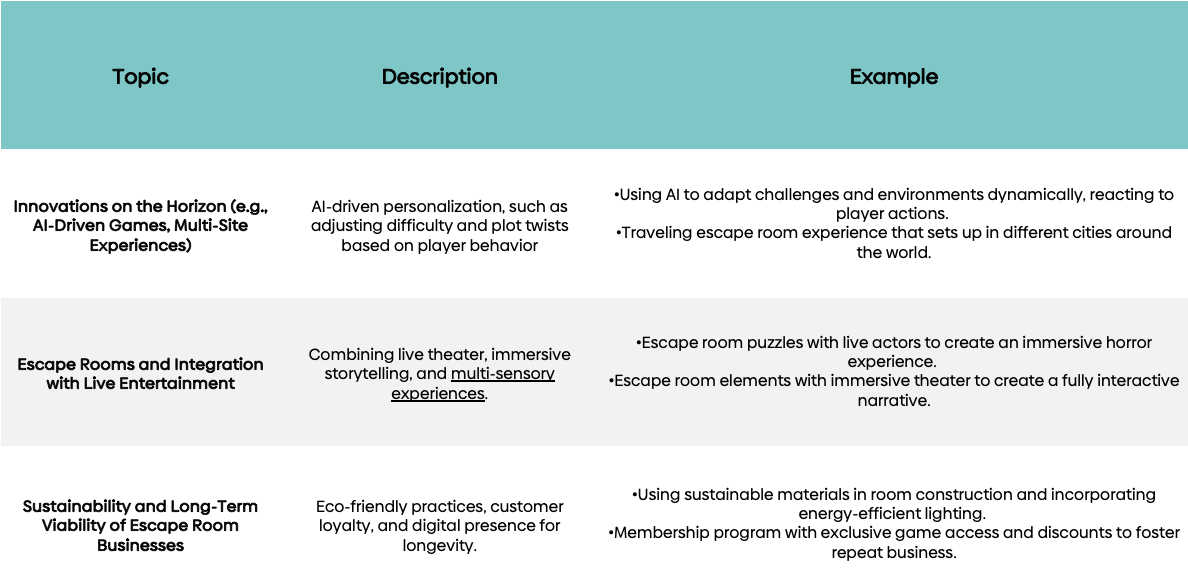
As the industry continues to evolve, the path forward is filled with endless possibilities, offering innovative, immersive, and sustainable experiences that will shape the next generation of escape room entertainment.
To move forward, we must embrace innovation and continually adapt to changing customer demands. That way, we can stay ahead of the competition and deliver unforgettable experiences that keep players coming back.
Key Takeaways
- Escape rooms offer significant growth potential by focusing on innovative, immersive experiences.
- They have evolved beyond a fad, becoming a long-lasting trend in the entertainment industry.
- Escape rooms are accessible to a wide range of audiences as they prioritize mental challenges over physical skills.
Frequently Asked Questions
Is an Escape Room Business Profitable?
Yes, an escape room business can be highly rewarding and profitable for those passionate about delivering immersive and engaging experiences. With creativity, customer focus, and effective marketing, escape room businesses can thrive, offering unique entertainment that appeals to a broad audience. The industry's capacity for innovation and adaptability also suggests a solid foundation for long-term success.
Are Escape Rooms a Growing Trend or Just a Fad?
Escape rooms are a growing trend, not a fad. They have gained global popularity for their innovative and immersive experiences. The industry continues to evolve, integrating new technologies and themes to maintain freshness and engagement. This adaptability and increasing demand for experiential entertainment indicate that escape rooms will remain popular.
Do Escape Rooms Incorporate Elements of Physical Fitness or Agility?
Escape rooms primarily focus on mental challenges rather than physical fitness or agility. They are designed to engage cognitive skills through puzzles and interactive storytelling, with only mild physical activities involved in some rooms. This approach makes escape rooms accessible and enjoyable for a wide range of participants, emphasizing brain-teasing fun over physical exertion.

How to Start a Party Rental Business in 10 Steps
Starting a party rental business is a fantastic way to bring joy and excitement into people's lives while building a profitable venture for yourself. Whether you want to go full-time or start small, this is an industry that requires minimal upfront investment, serves local communities and events, and offers flexible growth potential.
So, if you're ready to create memorable events and grow a thriving business, let's get started on this exciting adventure together!
Party Rental Businesses
Starting a party rental business might seem like a big leap, but in reality, the demand is always there. Across the country, customers are constantly looking for reliable and affordable rentals that offer delivery and setup services and can bring their events to life.
The best place to start? Focus on what excites you most about the industry. Do you love the energy of kids’ parties? The elegance of weddings? The polish of corporate events? Let your passion guide your niche.
To help spark ideas, here are some of the most in-demand types of party rental businesses:
1. Tent Rentals - From backyard weddings to large corporate events, tent rental companies provide event equipment for rent and create a safe, stylish shelter.
- Why customers love it: Tents create a blank canvas for any event theme while protecting guests from the elements.
- Who it's for: Event planners and hosts working on weddings, fundraisers, or festivals where the weather is unpredictable but style matters.
2. Photo Booth Rentals - From high-tech selfie stations to themed photo setups, these rentals create entertainment and lasting take-home memories.
- Why customers love it: Photo booths are a built-in attraction that adds entertainment and creates instant keepsakes.
- Who it's for: Wedding receptions, birthday parties, and corporate events looking to boost guest interaction.
3. Event Furniture Rentals - Think chic lounge areas, cocktail tables, and stylish seating. Furniture rental companies help transform plain venues into polished, on-brand experiences.
- Why customers love it: High-end furniture elevates the look of an event without the hassle or cost of buying it.
- Who it's for: Ideal for weddings, VIP events, product launches, and conferences where ambiance and aesthetic are everything.
4. Inflatables & Kids' Party Rentals - Bounce houses and inflatable obstacle courses make children’s events easy to organize and fun to attend.
- Why customers love it: These rentals keep kids active, entertained, and turn a regular backyard into a full-blown party zone.
- Who it's for: Perfect for parents, schools, and community organizers throwing birthday parties, fairs, or fun days.
10 Steps to Start a Party Rental Business
Starting a party rental business involves careful planning and execution. Here are ten essential steps to establish and launch your venture successfully:
1. Conduct Market Research
Understand your local audience, competitors, and the most-requested rentals. Focus on what targets event planners and private customers in your area. This will help you determine what types of events are most common and which rental items are in high demand, guiding you to make informed decisions about your inventory and marketing strategies.
2. Create a Party Rental Business Plan
Outline your business model, financials, and how your business will stand out. Include whether you’ll offer packages, use tiered pricing models for rentals, or focus on a specific niche. This document will serve as a roadmap for your business, helping you to stay focused and organized.
3. Identify Profitable Niches
Specializing allows you to stand out. Maybe your business benefits from seasonal promotions, or maybe it thrives on partnerships with venues. Whether you cater to weddings, birthdays, or corporate functions, focusing on a niche can help you tailor your inventory and marketing efforts to meet specific needs.
4. Form a Legal Business Entity
A rental business needs insurance and business registration to operate smoothly and with credibility. Decide on the legal structure of your business (e.g., sole proprietorship, partnership, LLC) and register your business and take care of legalities. This step is essential for legal protection, tax purposes, and establishing credibility with customers and vendors.
5. Secure Funding for Your Party Rental Business
Calculate the initial investment needed to start your business, including costs for inventory, storage, delivery vehicles, and marketing. Explore funding options such as small business loans, investors, or crowdfunding to cover these startup costs.
6. Purchase Party Rental Equipment
Invest in party rental equipment that will withstand frequent use. Start with versatile, high-use items. Think tables, chairs, tents, and décor, the kind of inventory that’s durable, reusable, and in constant demand. Building a diverse inventory will enable you to cater to the various needs and preferences of different customers.
7. Build an Effective Website and Online Presence
In today's digital age, a professional website and strong online presence are crucial for attracting customers. Ensure your website is user-friendly, showcases your inventory with high-quality images, includes clear contact information, and has a clean and intuitive booking interface. Utilize social media platforms to engage with potential customers and promote your services.
8. Select a Delivery Vehicle
Your success relies on reliable transportation logistics, especially for larger setups like tents or event furniture. The size and type of vehicle will depend on the scale of your inventory and the types of events you cater to.
9. Acquire Storage for Your Party Rental Business
Store equipment in secure warehouse spaces that are clean, climate-controlled, and well-organized. Consider the size of your inventory and potential growth when selecting a storage facility or warehouse.
10. Obtain Necessary Permits and Licenses
Your company must comply with local business regulations, which may include zoning approvals, insurance, sales tax permits, and safety checks.
How to Grow Your Party Rental Business
Expanding your party rental business requires a strategic approach, focusing on enhancing your services, reaching new markets, and continuously meeting the evolving needs of your customers. Here are key strategies to consider for growth:
Upgrade Your Party Rental Equipment as Needed
- Stay Current with Trends: Regularly research the latest trends in the event industry and update your inventory with popular and in-demand items. Offering trendy and unique rental options can set your business apart and attract a broader client base.
- Invest in Quality: Prioritize the quality and condition of your rental equipment. Upgrading to higher-quality, durable items can reduce maintenance costs over time and improve customer satisfaction.
- Expand Your Inventory: Continuously assess your inventory and consider adding new types of items that complement your existing offerings. This could include expanding into new categories like technology-enhanced products or eco-friendly options.
Expand to New Locations
- Market Research: Before expanding, conduct thorough market research in potential new locations to understand the local demand, competition, and event trends. This will help you tailor your offerings and marketing strategies to the new market.
- Strategic Partnerships: Establish partnerships with local venues, event planners, and other vendors in the new location. These relationships can provide valuable referrals and insights into the local event scene.
- Localized Marketing: Implement marketing strategies that resonate with the local community. Engage in local events, sponsor community activities, and use targeted advertising to raise awareness of your brand in the new area.
Offer Additional Services and Upselling
- Complementary Services: Consider offering services that complement your rental business, such as event planning, coordination, or decoration services. This can provide a more comprehensive solution for your clients, enhancing their experience and increasing your revenue.
- Package Deals: Create package deals that bundle various items and services at a discounted rate. Packages make decision-making easier for clients and can increase the average transaction size.
How Much Does it Cost to Start a Party Rental Business?
Venturing into the party rental business offers an exciting opportunity for entrepreneurs looking to tap into the vibrant event industry. This sector is about bringing joy and entertainment to various celebrations and creating a sustainable and profitable business model with a relatively low barrier to entry.
Initial Costs Breakdown
Embarking on a party rental business journey can begin with an investment of under $5,000. * This initial investment covers essential equipment, such as inflatable bounces or slides, which are staples for any party rental company.
While keeping the investment on the lower end, around $4,000 to $5,000, it's imperative to account for necessary expenses beyond just equipment, with insurance being a notable example. * Insurance is vital in this industry, protecting your assets and operations.
Exploring the Income Potential
The income potential in the party rental business varies significantly based on scale, location, and the diversity of services offered. Some businesses may see earnings starting at $20,000, while others in more lucrative markets or with a broader service range can achieve incomes in the millions. *
Operating from Home: A Cost-Effective Strategy
One of the appealing aspects of starting a party rental business is the feasibility of operating from home during the initial phases. This approach significantly reduces overhead costs, allowing entrepreneurs to reinvest profits into expanding their inventory and services. Starting part-time and gradually transitioning to a full-time operation as the business grows is a common and strategic approach, providing flexibility and minimizing financial strain.
How to Market for Party Rentals
If you’re running a party rental business and relying only on word of mouth or the occasional Facebook post, you’re likely leaving money on the table.
Let's say you have a small inflatable rental business in Austin. You’ve listed your bounce houses on Facebook Marketplace and maybe even dropped a few flyers around town. But bookings are still inconsistent, and growth feels stuck. That’s when you decide to take a more intentional approach.
You begin to optimize your website so that when parents search “bounce house rentals near me” or “kids’ party rentals in Austin,” your business actually shows up. Then you start posting short, fun videos on Instagram: quick setup time-lapses, even funny behind-the-scenes moments from events. You tag the venues and use local hashtags to get discovered.
Then you launch a referral program: $25 credit to anyone who sends a new customer your way. Suddenly, past clients are sharing your info in neighborhood Facebook groups, and your calendar starts filling faster than you expected.
That’s what effective marketing looks like for a party rental business. Allow us to explain further:
- Social Media Campaigns: Use Instagram and TikTok to showcase your setups, post event transformations, and engage with your local community. Visual platforms help potential customers see the quality of your rentals and imagine them at their event.
- Local SEO: Optimize your website and other content with event-related keywords like “wedding tent rentals” or “photo booth rentals [city]” to appear in local Google searches. This helps you appear when people are actively planning events and ready to book.
- Referral Programs: Encourage your happiest customers to do your marketing for you. You’d be surprised how quickly your business builds trust through positive reviews and social shares.
The difference between just being online and marketing with purpose is massive. The most successful operators don’t wait around for customers to find them. Instead, they go out and get in front of the right people.
A strong marketing strategy not only increases visibility but also leads to steady bookings, repeat customers, and brand loyalty that pays off over time.
Common Challenges in Party Rental Businesses
Every party rental business runs into bumps along the way. Here are some of the most common challenges rentals face and why solving them pays off:
- Inventory Damage and Wear: Your rentals are constantly on the move, getting packed, set up, and used at events of all kinds. It’s no surprise that chairs get scuffed, bounce houses tear, and table linens go missing.
The value of solving it: Staying ahead of wear and tear with regular inspections and backups can prevent event-day disasters and protect your reputation.
- Scheduling Conflicts: Double-booked items or last-minute changes can turn a smooth weekend into a logistical headache.
The value of solving it: Reliable scheduling and calendar tools help avoid overlap, giving your team confidence and customers peace of mind.
- Weather Disruptions: Outdoor events are a gamble, especially with tent rentals or inflatables. A rainy weekend can mean canceled bookings or expensive cleanup.
The value of solving it: Having flexible policies, clear contracts, and contingency plans helps protect your business and keep clients happy.
- Storage and Organization Issues: As your inventory expands, so does the need for organized storage. Spreading equipment across multiple locations can make it hard to track availability, cleanliness, and maintenance needs.
The value of solving it: Organized, centralized storage reduces loss, shortens prep time, and makes scaling your business a lot easier.
Key Takeaways
- Profitability Potential: A party rental business offers significant profitability potential through strategic planning, diversified inventory, and effective marketing, especially when operational costs are minimized.
- Insurance Requirement: Obtaining comprehensive insurance coverage, including general liability and property insurance, is crucial for protecting the business against liabilities and accidents, thereby ensuring its financial stability and enhancing credibility with clients.
- Storefront Not Essential: Starting and operating a party rental business does not require a physical storefront, allowing for a more flexible and cost-effective business model that can significantly reduce initial overhead expenses.
Frequently Asked Questions
Is a Party Rental Business Profitable?
Yes, a party rental business is profitable with proper planning, a diverse inventory, and effective marketing. Profitability varies based on operational efficiency and market demand, with the potential for significant income growth by maintaining low overhead costs.
Do I Need Insurance for My Party Rental Business?
Yes, you need insurance to start a party rental business. Insurance is essential for a party rental business to protect against liability and accidents. Essential coverage includes general liability, property, and potentially workers' compensation.
Do I Need a Physical Storefront to Operate a Party Rental Business?
No, a physical storefront is not necessary to start a party rental business. Many operate successfully from home or a storage facility, reducing overhead costs. A storefront may be considered for growth, but it is not essential for initial operations.


