%201.jpg)
Many travel operators face high competition and low visibility on Online Travel Agency (OTA) platforms. You’ve got a gorgeous property, epic adventure tours, or killer kayaking rentals, but your listings are buried under a pile of lookalikes on booking platforms.
This scenario haunts countless property managers and hoteliers daily. Strategic OTA marketing helps maximize revenue per booking, reduce reliance on single platforms, and build sustainable growth that withers algorithm changes and market shifts.
The difference between thriving and surviving on OTA platforms comes down to proven strategies. Let’s break down actionable and ROI-focused marketing tactics to help you improve conversion rates and operate more strategically.
Key OTA Marketing Strategies to Boost Business Visibility and Revenue
When used strategically, OTA platforms can serve as revenue-generating engines, offering travel-specific exposure to a global audience. But to get results, your strategy must be scalable and conversion-oriented.
Optimize OTA Listings for High-Value Bookings
A well-optimized listing attracts the right users and increases the likelihood of bookings. Focus on SEO strategies for local and global search visibility.
- Use professional photos that highlight your property, rooms, or tour experiences.
- Write clear, keyword-rich descriptions that include all amenity and service details.
- Maintain accurate availability to improve your listing’s position in OTA search results.
- Optimize websites for mobile users to capture traffic from smartphones and tablets.
- Focus on target audience segmentation by tailoring copy and features to different traveler types (families, business travelers, etc.).
Don’t forget to refresh your photos and descriptions at least once a year. Platforms like Booking.com and Airbnb favor updated listings in search rankings.
Implement Competitive, Data-Driven Pricing
To stay competitive and maximize rates, leverage dynamic pricing tools that adjust based on demand, competition, and booking history.
- Set minimum and maximum rate boundaries to protect your margins during fluctuations.
- Monitor competitors’ prices using benchmarking tools.
- Analyze trends using data-driven insights to refine pricing models throughout the year.
You can also integrate AI for dynamic pricing, allowing your pricing to adjust automatically according to the season.
Leverage Reviews to Build Trust and Ranking
Prioritize customer reviews and testimonials as these can influence visibility and guest trust on OTAs.
- Encourage guests to leave reviews post-stay.
- Train staff to provide review-worthy service experiences.
- Respond promptly to both positive and negative reviews to demonstrate engagement.
Take this one step further by focusing on user-generated content (UGC) for social proof and content marketing. Positive user-generated content can be repurposed for your website and social channels to reinforce legitimacy and increase conversions.
Run Seasonal Campaigns and Limited-Time Offers
Aligning your promotions with key seasons or local events like New Year’s Day, Easter, Halloween, and even Black Friday Sales can help boost bookings.
- Develop seasonal promotions to drive bookings during peak travel times.
- Feature special deals through pay-per-click (PPC) ads.
- Use urgency messaging to encourage early reservations.
- Offer value-added amenities such as complimentary breakfast, parking, or late checkout.
Pair this with retargeting ads to ensure travelers who browsed but didn’t book get reminded of your promotions at just the right time.
Just be careful with OTA rate parity, which means your prices must remain consistent across all channels. So instead of undercutting OTAs with cheaper rates, add extra value through perks or bonuses on your direct bookings.
Drive Direct Bookings Without Violating OTA Policies
Relying on OTAs alone limits your profit margins and control over the customer relationship. Direct bookings offer better profitability, full access to customer data, and allow you to nurture long-term relationships.
- Place branded print materials (postcards, brochures, QR codes) to discreetly promote your direct website.
- Offer exclusive return-guest discounts for those who rebook directly.
- Use permission-based branded email marketing to follow up after their stay.
- Promote seasonal promotions and perks only available via direct bookings.
These compliant tactics protect your OTA standing while building a base of repeat guests directly. Just make sure that the prices remain the same across OTAs and direct platforms.
Hotel OTA Optimization
For hotels, success on OTAs goes beyond polished listings. The real advantage comes from strategic rate plans, smart distribution, and strong brand positioning.
- Diversify rate plans: Offer flexible cancellation, early-bird discounts, and bundled packages with meals, spa access, or tours to attract different traveler types.
- Use a channel manager: Sync rates and availability across OTAs, your direct booking engine, and metasearch platforms to maintain consistency and avoid overbookings.
- Highlight your brand identity: Showcase unique experiences such as rooftop dining, eco-friendly initiatives, or cultural activities to differentiate your property from competitors.
- Leverage data-driven insights: Track booking patterns, campaign performance, and guest demographics to refine offers and identify opportunities in international markets.
Bonus: Regularly monitor competitor strategies to stay one step ahead in highly competitive markets.
OTA vs Direct Sales: A Comparison
Which marketing channel should you allocate more to? Here’s a quick comparison between OTA and direct sales.
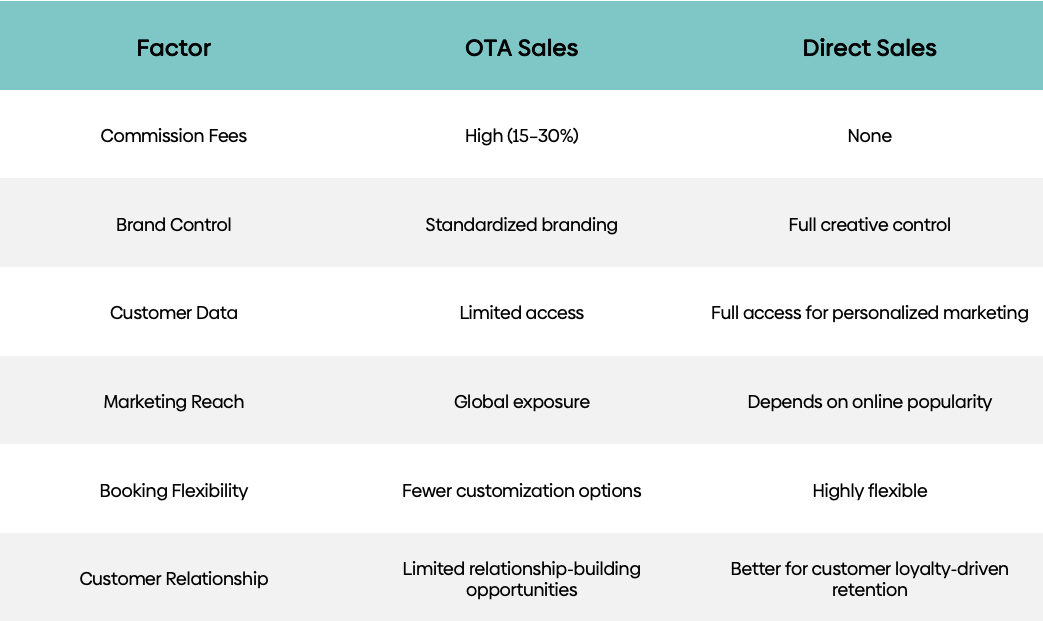
How to Balance OTA and Direct Bookings in a Smart OTA Strategy
Striking the right balance between OTA reliance and direct bookings is less about individual perks and more about shaping a sustainable distribution strategy.
- Define channel roles: Treat OTAs as discovery platforms that attract new audiences, while positioning your website and direct booking engine as the home for repeat and loyal customers.
- Monitor performance across channels: Use analytics to track which platforms drive the most profitable guests and adjust your marketing spend accordingly.
- Invest in multi-channel visibility: Pair OTA exposure with search engine marketing (SEM), Google Ads, and social media campaigns to stay visible across the traveler journey.
For more ways to strengthen your distribution strategy, check out these powerful marketing tools for tour and activity operators that can help boost visibility.
Opportunities and Challenges in OTA Business Models
The OTA market size is expected to reach $1.19 trillion by 2029 at a 6.2% CAGR. This growth is fueled by rising disposable income, faster economic recovery, and massive adoption of mobile and online booking channels.
This simply means that the OTA landscape is a market full of opportunities, offering travel operators more ways than ever to reach global audiences and grow revenue.
However, using OTAs effectively requires evaluating costs, adaptability, and long-term scalability. Typical OTA commission rates range from 15% to 30%. These costs cover wide distribution, exposure, and instant credibility. But they can erode profit margins, making direct bookings more important over time.
To break away from this, avoid over-reliance and diversify by:
- Listing on multiple platforms.
- Having affiliate marketing partnerships with bloggers and influencers to gain exposure.
- Running targeted Facebook and Instagram ads for demographic reach.
- Expanding into international markets with localized campaigns.
It’s equally important to stay agile. OTA platforms frequently update algorithms and policies, which can impact your visibility and even how your listings appear.
Stay current with changes in platform policies and maintain a flexible, innovative diversification strategy to enhance competitiveness, protect profitability, and ensure your strategy remains resilient against market shifts.
If you’re new to OTA platforms and want to understand how they work, our online travel agent guide breaks down the fundamentals and key strategies to help you get started.
Key Takeaways
- Optimize OTA listings with photos, keywords, and mobile-first design to boost visibility.
- Use dynamic pricing, reviews, and seasonal offers to drive more bookings and revenue.
- Balance OTA exposure with direct booking efforts to maintain customer relationships and improve profitability.
Frequently Asked Questions
How Do I Improve My OTA Ranking through OTA Optimization?
Boost your OTA ranking by uploading high-quality photos, responding to guest reviews, and keeping your availability and pricing up to date. Encourage satisfied guests to leave positive reviews and ensure your listing descriptions are complete and accurate.
Are OTA Advertising Campaigns Worth the Cost?
Yes, OTA advertising can be worthwhile if your return on investment (ROI) exceeds the spend. Paid visibility tools work best for high-converting listings, during peak seasons, or when launching a new property. Always track ROI through bookings and revenue.
What is "Rate Parity," and How Does It Affect My OTA Strategy?
Rate parity means your listed prices must match across OTAs and your own site. Breaking parity can lead to penalties or reduced visibility. Prevent issues by syncing pricing tools and reviewing OTA terms regularly.
Table of contents
Many travel operators face high competition and low visibility on Online Travel Agency (OTA) platforms. You’ve got a gorgeous property, epic adventure tours, or killer kayaking rentals, but your listings are buried under a pile of lookalikes on booking platforms.
This scenario haunts countless property managers and hoteliers daily. Strategic OTA marketing helps maximize revenue per booking, reduce reliance on single platforms, and build sustainable growth that withers algorithm changes and market shifts.
The difference between thriving and surviving on OTA platforms comes down to proven strategies. Let’s break down actionable and ROI-focused marketing tactics to help you improve conversion rates and operate more strategically.
Key OTA Marketing Strategies to Boost Business Visibility and Revenue
When used strategically, OTA platforms can serve as revenue-generating engines, offering travel-specific exposure to a global audience. But to get results, your strategy must be scalable and conversion-oriented.
Optimize OTA Listings for High-Value Bookings
A well-optimized listing attracts the right users and increases the likelihood of bookings. Focus on SEO strategies for local and global search visibility.
- Use professional photos that highlight your property, rooms, or tour experiences.
- Write clear, keyword-rich descriptions that include all amenity and service details.
- Maintain accurate availability to improve your listing’s position in OTA search results.
- Optimize websites for mobile users to capture traffic from smartphones and tablets.
- Focus on target audience segmentation by tailoring copy and features to different traveler types (families, business travelers, etc.).
Don’t forget to refresh your photos and descriptions at least once a year. Platforms like Booking.com and Airbnb favor updated listings in search rankings.
Implement Competitive, Data-Driven Pricing
To stay competitive and maximize rates, leverage dynamic pricing tools that adjust based on demand, competition, and booking history.
- Set minimum and maximum rate boundaries to protect your margins during fluctuations.
- Monitor competitors’ prices using benchmarking tools.
- Analyze trends using data-driven insights to refine pricing models throughout the year.
You can also integrate AI for dynamic pricing, allowing your pricing to adjust automatically according to the season.
Leverage Reviews to Build Trust and Ranking
Prioritize customer reviews and testimonials as these can influence visibility and guest trust on OTAs.
- Encourage guests to leave reviews post-stay.
- Train staff to provide review-worthy service experiences.
- Respond promptly to both positive and negative reviews to demonstrate engagement.
Take this one step further by focusing on user-generated content (UGC) for social proof and content marketing. Positive user-generated content can be repurposed for your website and social channels to reinforce legitimacy and increase conversions.
Run Seasonal Campaigns and Limited-Time Offers
Aligning your promotions with key seasons or local events like New Year’s Day, Easter, Halloween, and even Black Friday Sales can help boost bookings.
- Develop seasonal promotions to drive bookings during peak travel times.
- Feature special deals through pay-per-click (PPC) ads.
- Use urgency messaging to encourage early reservations.
- Offer value-added amenities such as complimentary breakfast, parking, or late checkout.
Pair this with retargeting ads to ensure travelers who browsed but didn’t book get reminded of your promotions at just the right time.
Just be careful with OTA rate parity, which means your prices must remain consistent across all channels. So instead of undercutting OTAs with cheaper rates, add extra value through perks or bonuses on your direct bookings.
Drive Direct Bookings Without Violating OTA Policies
Relying on OTAs alone limits your profit margins and control over the customer relationship. Direct bookings offer better profitability, full access to customer data, and allow you to nurture long-term relationships.
- Place branded print materials (postcards, brochures, QR codes) to discreetly promote your direct website.
- Offer exclusive return-guest discounts for those who rebook directly.
- Use permission-based branded email marketing to follow up after their stay.
- Promote seasonal promotions and perks only available via direct bookings.
These compliant tactics protect your OTA standing while building a base of repeat guests directly. Just make sure that the prices remain the same across OTAs and direct platforms.
Hotel OTA Optimization
For hotels, success on OTAs goes beyond polished listings. The real advantage comes from strategic rate plans, smart distribution, and strong brand positioning.
- Diversify rate plans: Offer flexible cancellation, early-bird discounts, and bundled packages with meals, spa access, or tours to attract different traveler types.
- Use a channel manager: Sync rates and availability across OTAs, your direct booking engine, and metasearch platforms to maintain consistency and avoid overbookings.
- Highlight your brand identity: Showcase unique experiences such as rooftop dining, eco-friendly initiatives, or cultural activities to differentiate your property from competitors.
- Leverage data-driven insights: Track booking patterns, campaign performance, and guest demographics to refine offers and identify opportunities in international markets.
Bonus: Regularly monitor competitor strategies to stay one step ahead in highly competitive markets.
OTA vs Direct Sales: A Comparison
Which marketing channel should you allocate more to? Here’s a quick comparison between OTA and direct sales.
How to Balance OTA and Direct Bookings in a Smart OTA Strategy
Striking the right balance between OTA reliance and direct bookings is less about individual perks and more about shaping a sustainable distribution strategy.
- Define channel roles: Treat OTAs as discovery platforms that attract new audiences, while positioning your website and direct booking engine as the home for repeat and loyal customers.
- Monitor performance across channels: Use analytics to track which platforms drive the most profitable guests and adjust your marketing spend accordingly.
- Invest in multi-channel visibility: Pair OTA exposure with search engine marketing (SEM), Google Ads, and social media campaigns to stay visible across the traveler journey.
For more ways to strengthen your distribution strategy, check out these powerful marketing tools for tour and activity operators that can help boost visibility.
Opportunities and Challenges in OTA Business Models
The OTA market size is expected to reach $1.19 trillion by 2029 at a 6.2% CAGR. This growth is fueled by rising disposable income, faster economic recovery, and massive adoption of mobile and online booking channels.
This simply means that the OTA landscape is a market full of opportunities, offering travel operators more ways than ever to reach global audiences and grow revenue.
However, using OTAs effectively requires evaluating costs, adaptability, and long-term scalability. Typical OTA commission rates range from 15% to 30%. These costs cover wide distribution, exposure, and instant credibility. But they can erode profit margins, making direct bookings more important over time.
To break away from this, avoid over-reliance and diversify by:
- Listing on multiple platforms.
- Having affiliate marketing partnerships with bloggers and influencers to gain exposure.
- Running targeted Facebook and Instagram ads for demographic reach.
- Expanding into international markets with localized campaigns.
It’s equally important to stay agile. OTA platforms frequently update algorithms and policies, which can impact your visibility and even how your listings appear.
Stay current with changes in platform policies and maintain a flexible, innovative diversification strategy to enhance competitiveness, protect profitability, and ensure your strategy remains resilient against market shifts.
If you’re new to OTA platforms and want to understand how they work, our online travel agent guide breaks down the fundamentals and key strategies to help you get started.
Key Takeaways
- Optimize OTA listings with photos, keywords, and mobile-first design to boost visibility.
- Use dynamic pricing, reviews, and seasonal offers to drive more bookings and revenue.
- Balance OTA exposure with direct booking efforts to maintain customer relationships and improve profitability.
Frequently Asked Questions
How Do I Improve My OTA Ranking through OTA Optimization?
Boost your OTA ranking by uploading high-quality photos, responding to guest reviews, and keeping your availability and pricing up to date. Encourage satisfied guests to leave positive reviews and ensure your listing descriptions are complete and accurate.
Are OTA Advertising Campaigns Worth the Cost?
Yes, OTA advertising can be worthwhile if your return on investment (ROI) exceeds the spend. Paid visibility tools work best for high-converting listings, during peak seasons, or when launching a new property. Always track ROI through bookings and revenue.
What is "Rate Parity," and How Does It Affect My OTA Strategy?
Rate parity means your listed prices must match across OTAs and your own site. Breaking parity can lead to penalties or reduced visibility. Prevent issues by syncing pricing tools and reviewing OTA terms regularly.
Recommended Posts